How to Write in a Four-Line Notebook
By Team GrowthGoal · 5 min read
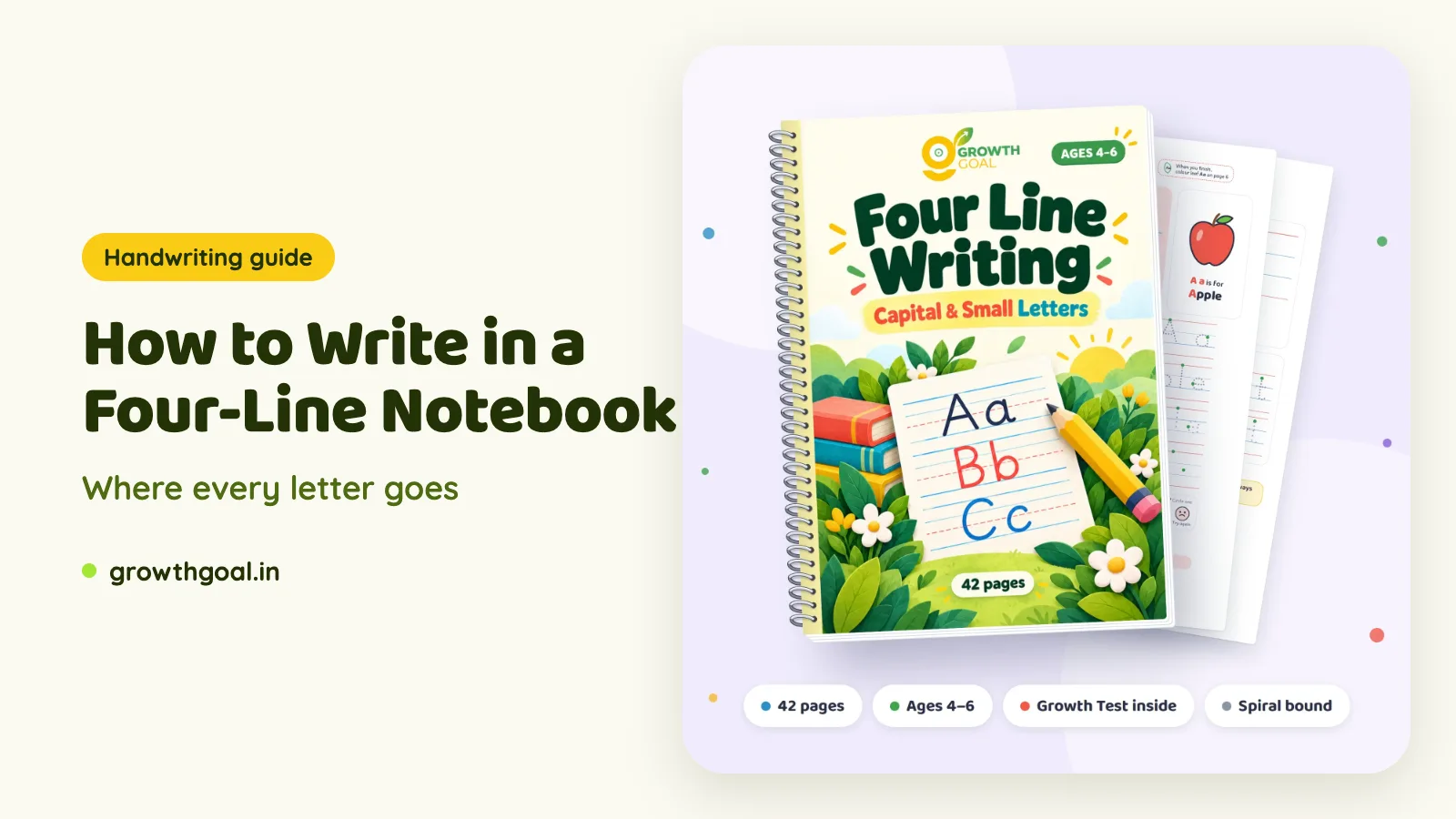
In a four-line notebook, small letters like a, c, e and o sit in the middle band between lines 2 and 3. Tall letters like b, d, h, k, l and t rise to line 1. Letters with tails like g, j, p, q and y drop down to line 4. All capital letters fill the space from line 1 to line 3. Once your child knows these four rules, almost every letter falls into place.
We hear this question from parents all the time, usually at 9 pm, with a half-finished homework page on the table. Don't worry. It looks confusing for about two days. After that, your child's hand starts to remember, and you'll barely need to remind them.
Why Indian schools use four-line notebooks
The four-line copy (also called a four-ruled notebook) is a standard in many Indian primary schools. It does one job really well: it shows a child exactly how tall each letter should be. That's why handwriting practised in four lines usually looks even and neat later, even on plain paper.
The four lines, named
Picture the lines from top to bottom:
| Line | Many teachers call it | What touches it |
|---|---|---|
| Line 1 (top) | Sky line | Tops of tall letters and capitals |
| Line 2 | Plane line | Tops of small letters |
| Line 3 | Grass line | Where every letter sits |
| Line 4 (bottom) | Ground line | Tails of g, j, p, q, y |
Many teachers use a colour version too: the middle band is often shaded or blue, and the base line red. Use whatever your child's school uses so home and school match.
Where each small letter goes
Middle band only (lines 2 to 3): a, c, e, i (the dot goes above), m, n, o, r, s, u, v, w, x, z
Up to the top line (lines 1 to 3): b, d, f, h, k, l. The letter t is a little shorter and usually stops between lines 1 and 2.
Down to the bottom line (lines 2 to 4): g, j, p, q, y
So f in print stays in the top three lines, but in some cursive styles it also drops to line 4. Check what your school follows.
We'd suggest saying the rule out loud while your child writes. "Small letters stay in the middle. Tall ones touch the sky. Tails go to the ground." Kids love it. Say it enough times and you'll hear them muttering it on their own.
Capital letters
Every capital letter starts at line 1 and sits on line 3. None of them go into the bottom band. J is the one to watch, because children often want to pull its hook down.
Numbers
Numbers usually follow capital letters: from line 1 down to line 3.
Common mistakes and quick fixes
| Mistake | Fix |
|---|---|
| Small letters floating above line 3 | "Every letter sits on the grass." Trace the base line in a colour first. |
| Tall letters stopping halfway | Put a small dot on line 1 where the letter should start. |
| Tails stopping at line 3 | Practise just g, j, p, q, y for two days. |
| Letters too wide | Practise inside boxes, one letter per box. |
| No gap between words | Use a finger space, or a small "o" space, between words. |
A simple practice routine
Keep it short. Really short. If your child is yawning or pressing hard enough to tear the page, you've gone too long, so stop and come back tomorrow.
- Day 1 to 3: Middle-band letters only. a, c, e, o, then m, n, r, s, u.
- Day 4 to 6: Tall letters. b, d, h, k, l, t, f.
- Day 7 to 9: Tail letters. g, j, p, q, y.
- Day 10 onwards: Three-letter words, then short sentences.
Ten to fifteen minutes a day is plenty for a young child. Stop while they're still enjoying it, and tell them what they did well. "Your g reached the ground today!" goes a long way.
Moving from four lines to normal ruling
You'll know your child is ready when you stop needing to point at the lines.
Usually by class 2 or 3, schools move to two-line and then single-line notebooks. If your child has learned the four-line rules properly, the transition is easy, because their hand already "knows" the heights. If letters start to wobble on single lines, give them a week of four-line practice again.
Practice books that help
- Four-Line Writing Book: Capital and Small Letters
- Small Letters Writing Practice Book A to Z
- 3-Letter Words and First Sentences Writing Practice
Questions people ask
What is a four-line notebook used for?
It's used to teach children the correct height of each English letter, so small, tall and tail letters are sized consistently.
Which letters touch the fourth line?
In print, the tail letters g, j, p, q and y. In some cursive styles, f and z also drop down.
Do capital letters go to the fourth line?
No. Capital letters go from the top line to the third line and never use the bottom band.
At what age should children start four-line writing?
Usually around 4 or 5, once they can trace lines and curves with control. Pencil-control practice comes first.