How to Write Fast and Neat in Exams
By Team GrowthGoal · 4 min read
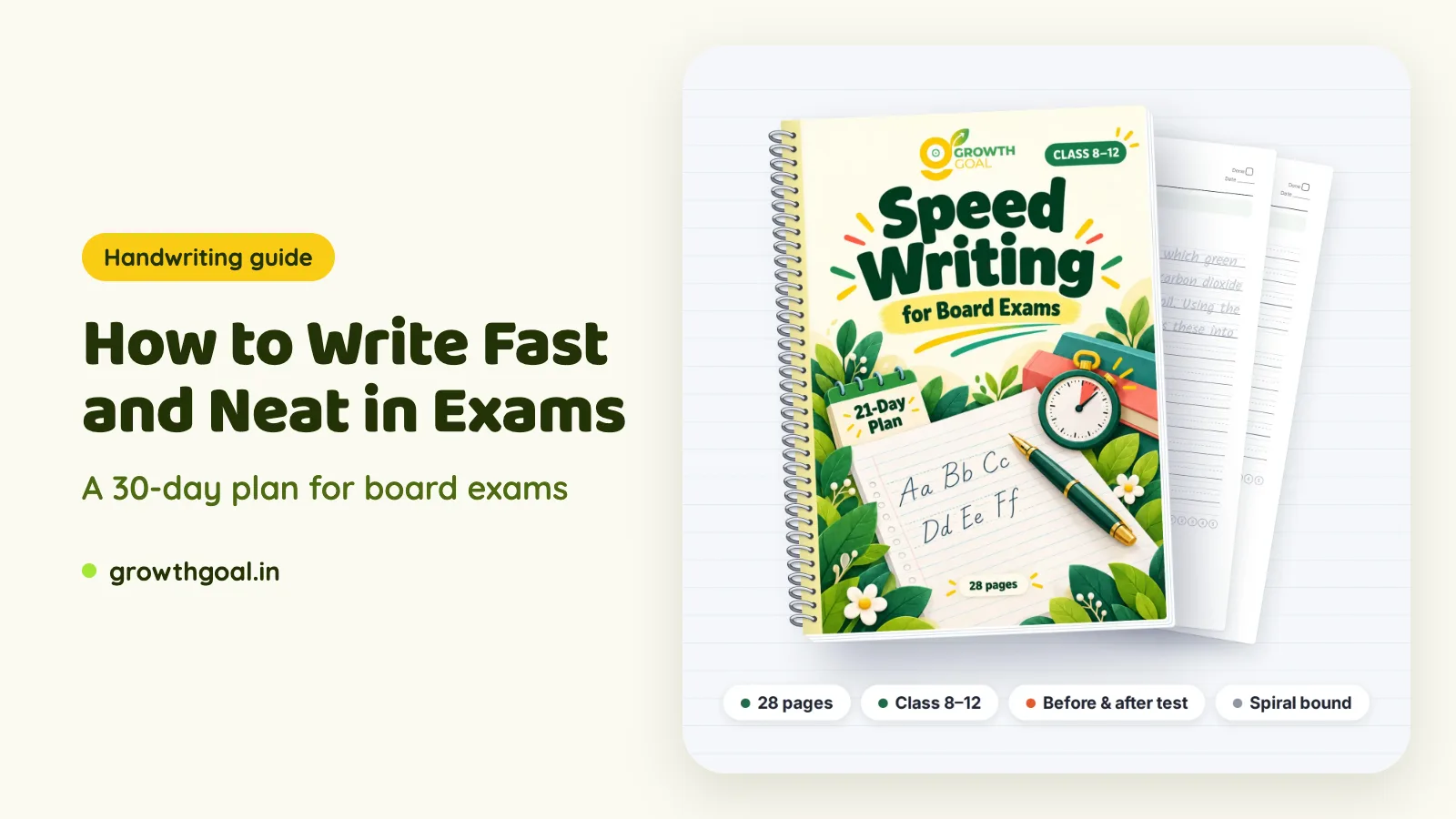
To write fast and neat in exams, practise timed writing every day for a few weeks before the exam, use a smooth pen you already know, keep a light grip, write in a simple joined or semi-joined style, and plan each answer in ten seconds before you start. Speed comes from fewer pauses and fewer pen lifts, not from moving your hand faster.
Why handwriting matters in board exams
An examiner checking hundreds of copies reads quickly. Clear handwriting, neat headings and well-spaced points make it easy to find what you know. Messy answers don't lose marks by rule, but an answer that's hard to read is an answer that's easy to misread.
And many students simply run out of time. In a three-hour paper, a slow writer can know every answer and still leave the last question blank.
1. Measure your speed first
Set a timer for five minutes and copy a paragraph from your textbook at your normal exam pace. Count the words and divide by five. That's your words per minute.
Do this once a week. Watching the number grow is a lot more motivating than "practise more."
2. Practise timed writing daily
From about six weeks before the exam, write one timed answer a day. Pick a real long-answer question, set the timer for the time it deserves in the paper, and write.
You're training three things at once: knowledge, speed and stamina. Your hand gets used to writing for long stretches without aching.
3. Use a pen you've practised with
Exam day is not the day to try a new pen. Choose a smooth gel or ball pen that doesn't skip, buy two or three of the same kind, and use them for all your practice.
4. Keep your grip light
A tight grip is the main reason hands hurt halfway through a paper. Hold the pen lightly, a couple of centimetres above the tip, and let your forearm rest on the desk. If your fingers ache, you're squeezing.
5. Join where it's easy
You don't need perfect cursive. Joining common pairs like "th," "in," "an," "er" and "ing" cuts down how often you lift the pen. Fewer lifts means more speed, without losing neatness.
6. Plan in ten seconds
Before you write a long answer, jot three or four keywords in the margin or on a rough page. Knowing where the answer is going stops you pausing mid-sentence, and pausing is where a lot of time disappears.
7. Make your answers easy to read
Neat doesn't only mean pretty letters. It means a page that's easy to read:
- Underline headings and key terms with a ruler or pencil.
- Write in short paragraphs or numbered points.
- Leave a line between answers.
- Draw diagrams in pencil and label them clearly.
- Write the question number clearly in the margin.
8. Don't let speed wreck your letters
If your writing gets messy when you go fast, find the exact letters that break. Usually it's a, o, d and g staying open, or e turning into a slash. Practise just those letters slowly for a few days, then speed up again.
9. Look after your hand during the exam
Every 30 to 40 minutes, take a few seconds to shake out your hand, stretch your fingers and roll your wrist. It sounds small, and it helps you stay fast till the end.
A 30-day speed plan
| Week | Daily practice (15 to 20 minutes) |
|---|---|
| 1 | Grip and posture, letters that break when you rush |
| 2 | Common letter joins, short timed paragraphs |
| 3 | One timed long answer a day with headings and points |
| 4 | Full section under time, check your words per minute |
Practice books that help
- Speed Writing Practice Book for Board Exams, Class 8 to 12
- 30-Day Handwriting Improvement Workbook for Students
- Essay Writing Print Handwriting Tracing Book
Questions people ask
How can I increase my writing speed in 7 days?
Do one timed answer a day, join the easiest letter pairs, use a smooth pen and keep a light grip. You'll see a jump within a week, though bigger gains need a month.
Does handwriting affect marks in board exams?
Marks are given for content, but an answer that's easy to read lets the examiner see all your points. Neat presentation helps your work get the attention it deserves.
Which pen is best for exams?
Whichever smooth pen you've practised with. Many students prefer a gel pen for its flow, while others find a ball pen less smudgy. Test both weeks before the exam.
Should I write in cursive in exams?
Write in whatever style you can keep neat at speed. A semi-joined style works well for many students.
My hand hurts during exams. What can I do?
Loosen your grip, rest your forearm on the desk, sit upright, and take short stretch breaks. If pain continues, practise daily with lighter pressure.