How to Improve Your Handwriting
By Team GrowthGoal · 6 min read
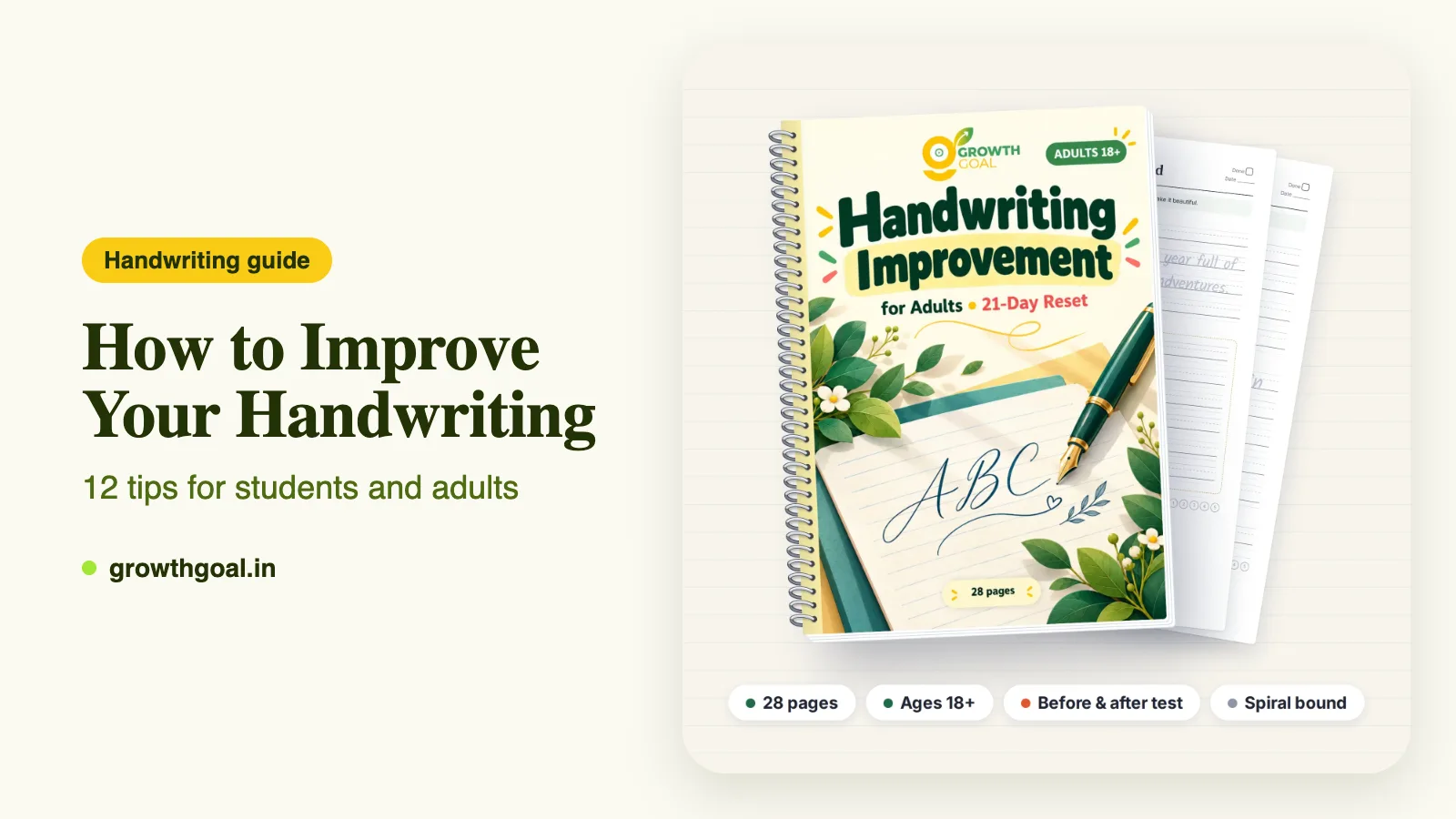
You can improve your handwriting at any age. Slow down, hold the pen loosely, pick one style and stick to it, and practise the basic strokes for about fifteen minutes a day. Most people see a clear difference within a few weeks. Below are twelve tips that work for school students and adults alike.
We've seen people in their forties fix handwriting they'd hated since school. It isn't magic. It's small, boring, daily practice, and it works.
First, a quick check
Write this sentence the way you normally do: The quick brown fox jumps over the lazy dog. It uses every letter of the English alphabet, so it shows you everything at once.
Now look at it and ask:
- Are the letters the same size?
- Do they lean the same way?
- Is the space between words even?
- Do letters like a, o, d and g close properly?
- Are the tall letters (b, d, h, k, l, t) actually taller?
Circle the two problems you see most. Those are what you'll fix first. Trying to fix everything at once is how people give up.
1. Slow down
Messy handwriting is very often just fast handwriting. When you rush, letters lose their shape, loops stay open, and words start to run into each other.
For the first two weeks, write at half your usual speed. Half. It'll feel painfully slow, almost silly, like learning to walk again after a sprained ankle. That's fine. Speed comes back on its own once the shapes are right.
2. Hold the pen loosely
A tight grip makes your hand tired and your letters shaky. Hold the pen between your thumb and first finger, resting on your middle finger, about two or three centimetres from the tip. If your knuckles turn white or the pen leaves a dent in your finger, you're squeezing too hard.
3. Write from your arm, not just your fingers
If only your fingers move, your hand gets tired quickly. Let your forearm rest on the desk and glide a little as you write across the line.
4. Sit well
Feet flat on the floor. Back straight. The paper tilted slightly: to the left if you're right-handed, to the right if you're left-handed. Your other hand holds the paper steady. It sounds basic, but posture changes a lot.
5. Choose the right pen
There's no single "best" pen. Try three or four: a gel pen, a ball pen, a fountain pen, a pencil. Pick the one that glides without skipping and doesn't need pressing. Many people find their writing gets neater the day they switch to a smoother pen.
6. Pick one style
Mixing print and cursive in the same word makes writing look untidy. Decide whether you'll write in print, cursive or a simple joined style, and practise only that. If you're not sure which suits you, our post on types of handwriting explains each one.
7. Practise the basic strokes
Almost every English letter is built from a few shapes: straight lines, slanting lines, circles, curves and loops. Before you write words, fill a line with each:
| | | | |straight downstrokes/ / / / /slants, all at the same angleo o o o ocircles that close neatlyc c c c copen curvesu u u u uandn n n n nhumps
Two or three minutes of this warms your hand up, like stretching before a game. Boring? A bit. Worth it? Every time.
8. Fix letter size with four-line or ruled paper
Uneven letter size is the most common problem. Practise on four-line or narrow-ruled paper so small letters (a, c, e, m) sit in the middle band and tall letters reach the top line. After a few weeks, your hand learns the sizes and you won't need the lines.
9. Keep spacing even
A simple trick: leave the width of one small "o" between words. Between letters inside a word, keep the gaps small and equal. Crowded words are hard to read even if every letter is perfect.
10. Keep a steady slant
Your letters can lean right, lean left or stand straight. Any of these can look good, as long as they all lean the same way. Draw a few faint slanting lines on your practice page and follow them for a week.
11. Practise little and often
Fifteen minutes a day beats two hours on Sunday. Short daily practice builds the habit without tiring your hand. Copy a paragraph from a book you like, a news article, or a thought for the day.
12. Compare every week
Keep your first "quick brown fox" sentence. Every Sunday, write it again underneath. Seeing the change week by week is the best motivation there is. Trust us.
A 21-day plan
| Days | Focus |
|---|---|
| 1 to 3 | Posture, grip, choose your pen and style |
| 4 to 7 | Basic strokes, then small letters a to z |
| 8 to 11 | Capital letters and tall letters |
| 12 to 15 | Spacing between letters and words |
| 16 to 18 | Short sentences at half speed |
| 19 to 21 | Paragraphs at normal speed, compare with day 1 |
Practice books that help
If you'd like the practice planned for you, these GrowthGoal workbooks follow exactly this kind of step-by-step path:
- Handwriting Improvement Workbook for Adults
- 30-Day Handwriting Improvement Workbook for Students
- Print Handwriting Practice Book: Beginner to Expert
For a free, detailed adult guide, Ireland's National Adult Literacy Agency also publishes Better Handwriting for Adults, which is worth a look.
Questions people ask
Can adults really improve their handwriting?
Yes. Handwriting is a motor skill, and motor skills keep responding to practice at any age. Adults often improve quickly because they can notice their own mistakes and practise with focus.
How long does it take to improve handwriting?
With fifteen minutes a day, most people see a visible difference in two to four weeks. Making the new style automatic takes longer, so keep going after it starts looking better.
Is cursive or print better for neat handwriting?
Either can be neat. Many adults find a simple joined style faster once it's learned. Pick the one you'll actually practise.
Why does my handwriting get worse when I write fast?
Because speed is pulling the letter shapes apart. Slow down until the shapes are automatic, then build speed gradually.
Does handwriting still matter?
It does, for exams, forms, notes and anything you sign. Many people also find writing by hand helps them think through ideas.