Calligraphy for Beginners
By Team GrowthGoal · 4 min read
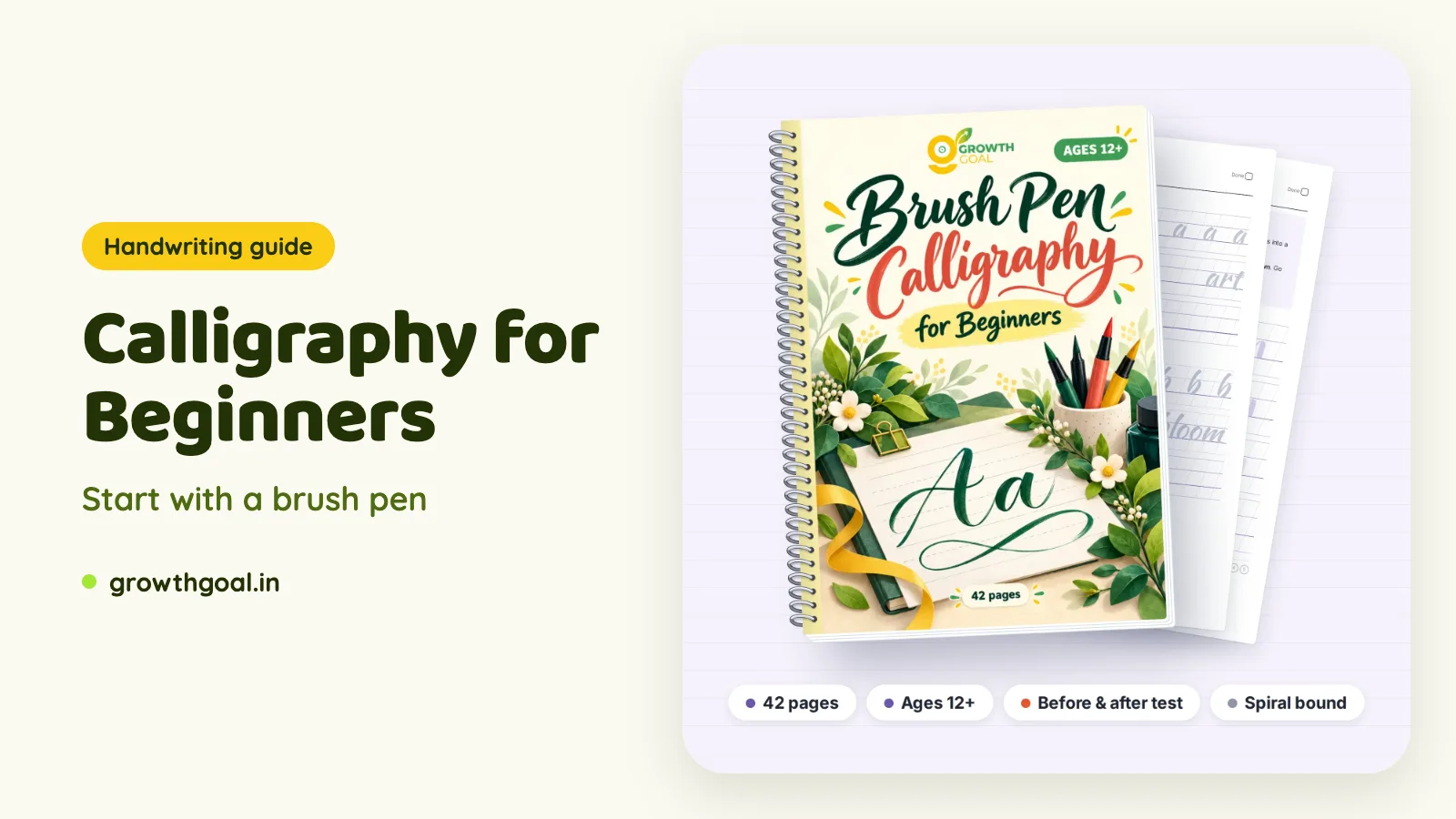
To start calligraphy as a beginner, you need just a brush pen, smooth paper and a practice sheet. The one rule that makes calligraphy look like calligraphy is simple: press hard on downstrokes, go light on upstrokes. Practise the basic strokes for a week before you try full letters, and you'll be writing your first beautiful words within a month.
Honestly, your first few pages will look wobbly. Ours did. That's not a sign you're bad at it; it's just what the first week of calligraphy looks like for everyone. Keep going and you'll be surprised how quickly it settles.
What calligraphy actually is
Calligraphy is writing where the thickness of the line changes. Thick lines where the pen moves down, thin lines where it moves up. That contrast is what makes it look elegant.
Traditional calligraphy uses a dip pen with a pointed or broad nib and ink. Modern calligraphy and brush lettering use a brush pen, which is much easier for beginners: no ink pots, no blots, and it fits in a pencil box.
What you need to start
- A brush pen. A small, firm tip is easier to control than a large soft one. Start small.
- Smooth paper. Rough paper frays the brush tip quickly. Laser printer paper or a smooth practice pad works well.
- Practice sheets with guidelines. They show the slant and the height of each letter.
- A pencil for sketching words before you ink them.
That's it. You don't need an expensive kit to begin.
The golden rule: thick down, thin up
Hold the pen at about a 45-degree angle, not upright.
- When your pen moves down the page, press so the brush spreads: a thick stroke.
- When your pen moves up, lift the pressure so only the tip touches: a thin stroke.
Practise this on its own for a few days. Draw a row of "u" shapes: thick on the way down, thin on the way up. It feels slow at first. That's normal. Calligraphy is slow writing.
The 8 basic strokes
Almost every letter in brush calligraphy is made from a few basic strokes. Learn these first:
- Thin upstroke
- Thick downstroke
- Overturn (a thin curve up, then thick down, like the hump of "n")
- Underturn (thick down, then thin up, like the bottom of "u")
- Compound curve (overturn and underturn joined)
- Oval (thick on the left side, thin on the right)
- Ascending loop (the tall loop in "l" and "h")
- Descending loop (the tail in "g" and "y")
Spend about a week here, ten or fifteen minutes a day. People who skip the basic strokes usually come back to them later.
Then letters, then words
Once the strokes feel comfortable:
- Week 2: small letters a to z, joining the basic strokes
- Week 3: capital letters
- Week 4: short words like "love," "thank you," "Diwali," your name
Lift your pen between strokes. In calligraphy, unlike fast handwriting, it's normal to stop and start again within a single letter.
Common beginner mistakes
| Mistake | Fix |
|---|---|
| Downstrokes shaky | Go slower. Shake comes from rushing. |
| Upstrokes too thick | Lighten pressure before the turn, not after. |
| Letters leaning different ways | Practise on slanted guidelines. |
| Brush tip fraying | Use smoother paper and don't press sideways. |
| Uneven spacing | Sketch the word lightly in pencil first. |
Where you can use it
- Birthday and Diwali cards
- Notebook and project headings
- Journals and planners
- Wedding and festival invitations for family
- Social media posts and posters
It also does something nice for everyday handwriting: the control you build carries over, and your regular writing often becomes steadier too.
Practice books that help
- Brush Pen Calligraphy Practice Book for Beginners
- Modern Calligraphy Alphabet Practice Sheets A to Z
Want to know how calligraphy fits with other styles? Read our post on types of handwriting.
Questions people ask
Can I learn calligraphy with bad handwriting?
Yes. Calligraphy is a different, slower way of making letters, so everyday handwriting doesn't hold you back. Many people find it actually improves their regular writing.
Which pen is best for calligraphy beginners?
A brush pen with a small, firm tip. It's easier to control than a large soft brush or a dip pen.
How long does it take to learn calligraphy?
With 15 minutes a day, most beginners can write neat words in about a month. Getting really good takes longer, and that's part of the fun.
What age can children start calligraphy?
Around 10 to 12, once their everyday handwriting and pencil control are steady.
Do I need special paper?
Smooth paper helps a lot because it protects the brush tip. Ordinary printer paper is fine for practice.